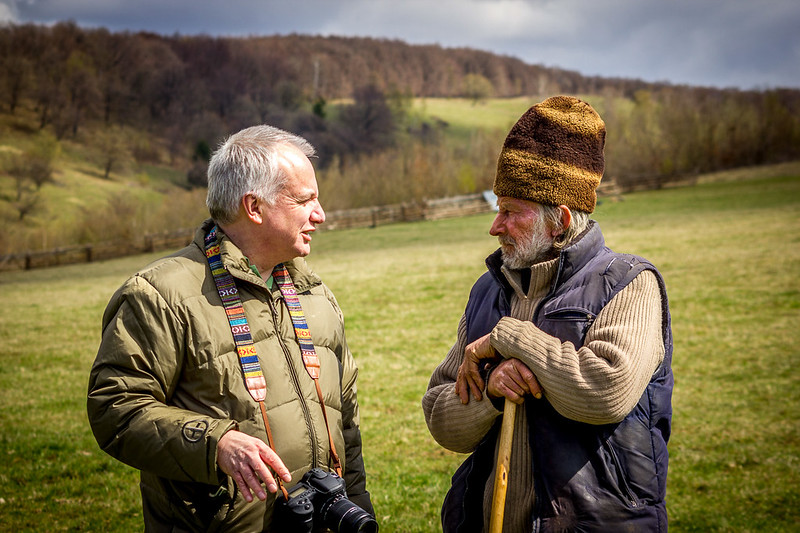
Why did I choose Transylvania to be my home? I have been asked this question many times by people that have never been here, but rarely by those that visit me. Of course the location we eventually choose depends on our personal motives, circumstances and aspirations. For me home is far more about quality of environment and the people we share our lives with, so relocating to Transylvania seemed a very logical decision.I am a Registered Nurse by profession and in 1993 I was invited to join an aid convoy delivering medical equipment to the hospital situated in the town of Kézdivásárhely. I only stayed for a week, but I immediately realised that this was the place for me. A combination of factors brought me to this decision, but the Székely people and their unique, sustainable relationship with the environment was the main attraction. Transylvania is a truly unique place and it is this uniqueness that I will attempt to portray through this blog.
After my initial introduction of one week, I soon returned for a further eighteen months, first to Kézdivásárhely (Târgu Secuiesc) where I worked work in the same hospital and then to Ozsdola (Ojdula) where I worked in a primary health care centre with my good friend Dr Turóczi Ildikó. I was an unpaid volunteer, so the harsh financial reality eventually forced me back to the UK to find salaried work. I must admit I found it hard to settle in the west and longed to return to Transylvania. After several years of working both in the UK and Germany, my opportunity to return to Ozsdola finally came in 2008. However, before relocating I first had to find somewhere to live!
I eventually bought an unfinished building on a large plot of land close to the centre of Ozsdola. However, with no water supply I soon had to get used to washing from a bucket with water carried from my neighbours well! With literally two cement lined rooms and a garage, a lot of work was required before I could really call this a house or even my home. Long deep trenches needed to be dug out for water pipes & drains, and a deep pit for a septic tank. This was all completed by hand by one of the great eccentrics of the village, Eugene Paizs commonly known as the bulldozer!
Life in Transylvania is so very different compared to what I was used to in the west, from bears wandering into the village in Autumn to living in a Szekely ethnic Hungarian community, descendants of the infamous Attila the Hun! I aim to document the lives and customs of local people, in a land which to many visitors appears to have stood still in time. However, these initial impressions can be deceptive as although horse and cart are still part of everyday life in Transylvania, modern tractors and farm machinery can also be seen on neighbouring fields. This strange paradox does not simply end there, as many villagers now have broadband internet but no running water or drains! Romania joined the European Union in 2007 resulting in rapid change. My aim to observe and document the day to day lives of the villagers in my adopted home, the challenges they face, and the subsequent effects on a traditional way of life that has survived for centuries.
Transylvania which has remained isolated by the magnificent Carpathian mountains is now opening its doors to the outside world with a new airport being built close to Brasov and the construction of the Transylvania highway. This new infrastructure will improve everyday life for many, and increase economic prosperity to the region, but there will inevitably be negative impacts too. There are already concerns relating to the dramatic increase in traffic using a road infrastructure struggling to keep pace with demand. Air quality too is bound to suffer in an environment that boasts some of the cleanest air in Europe.Fellow of the Royal Geographical Society